


Real-Time vs. Post-Match Data: What Really Matters in Football Analytics?

There is a persistent debate in football that keeps resurfacing: is real-time data the future, or will the real work still happen in post-match analysis?
On the surface, it is an easy topic to argue about. Live numbers feel modern and decisive. They promise instant answers: adjust the press now, see fatigue now, change the game plan now. Post-match work, by contrast, sounds quiet and old-school, something that happens in dark analysis rooms long after the crowd has gone home.
But the more football organisations we speak to, from clubs and academies to leagues and federations, the clearer it becomes that this is the wrong way to frame the question. The real tension is not between fast and slow. It is between data that can be trusted and data that only looks impressive on a screen.
In other words, the central question is this: can you trust your data enough, whether it is live during the game or processed after it, to make decisions that matter over weeks, months and seasons?
At ReSpo.Vision we work across multiple competitions and environments, and we often we see the same pattern. The teams that really win with data do not “pick a side” in the live versus post-match debate. They build a single, accurate tracking foundation and then use it in two layers: a live layer for the few decisions that can’t wait, and a post-match layer for the deeper work and long-term edge.
The reality behind real-time data
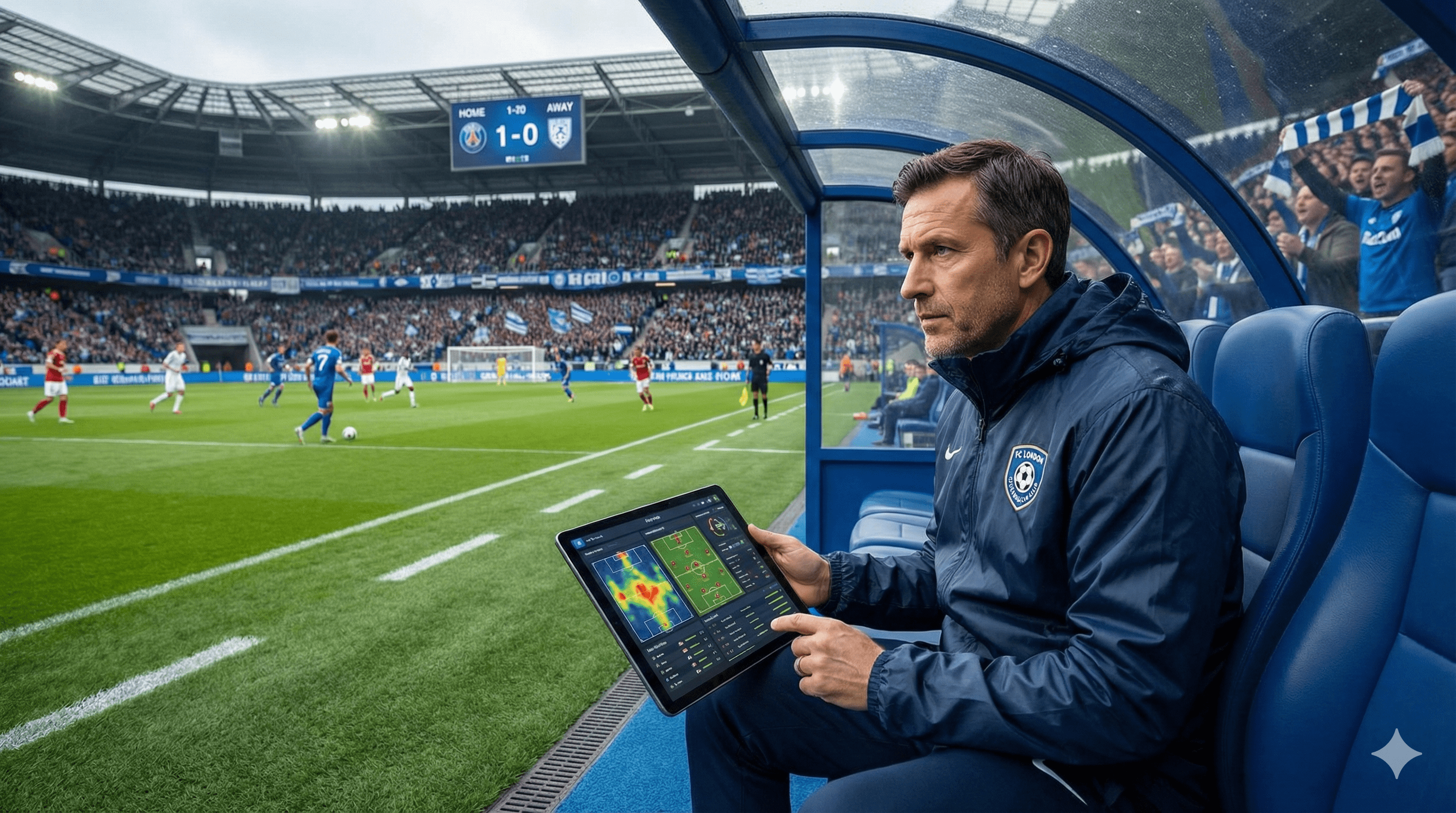
Real-time data absolutely has value. It powers the broadcast graphics that shape the fan’s understanding of the match. It underpins in-play betting markets. It can inform substitution decisions and confirm tactical impressions on the bench. When done well, it gives staff a pulse on the game as it unfolds: who is dropping physically, which side is being overloaded, and whether the press is still biting or visibly fading.
At the top end of the market, live systems can track players and the ball with significant spatial detail and generate sophisticated models on the fly. The underlying tracking itself can be extremely rich. However, there are hard limits to what can actually be used in the moment.
First, there is the human bottleneck. Even with several analysts on headsets, staff cannot digest complex spatial models, orientation fields, and multi-phase patterns within the 15 to 30 seconds when an intervention is possible. Whatever comes through to the technical area must be distilled into a few clear messages.
Second, there is decision pressure. During the game, the context is incomplete, emotions are high, and the cost of a wrong adjustment can be substantial. It is one thing to know that something looks off; it is another to change the structure based on a noisy metric that you have not tested across ten prior matches.
Third, there is the communication chain. Any insight has to travel from the data system to the analyst, then to the assistant, then to the head coach, and finally to the players in a form they can execute immediately. Each step reduces complexity and nuance.
Because of all this, the real-time layer tends to be much narrower than the full potential of tracking technology. In practice, live systems end up surfacing a very small subset of what they could, focusing on simple but robust indicators, a few tactical summaries and alerts that mostly confirm what coaches are already sensing from the touchline.
So the issue is not that real-time data is inherently “thin”. The issue is that, under matchday conditions, only a thin slice of it is realistically usable. The remaining analytical value belongs in the post-match workflow.
How post-match analysis powers performance
Once the final whistle goes, time is measured in hours and days rather than seconds. Analysts can let the full tracking pipeline run, validate the output and explore not just what happened but why it happened in that particular way. This is where post-match tracking data does the heavy lifting.
In this environment, you can understand how a team builds through phases, not just where passes occurred. You can see how defensive width and compactness change under different forms of pressure, rather than relying on a single freeze-frame. You can identify where pressing triggers actually succeed or break down, rather than only counting how often you tried to press.
You can also start to read intensity patterns that reveal much more than conditioning. Perhaps your team repeatedly drops in high-intensity actions between the 60th and 75th minute, or perhaps you discover that your supposedly “conservative” full-back is actually responsible for a large share of your deep runs into the final third. Those are the kinds of insights that change training design, game models and recruitment profiles, and they only emerge when you can study behaviour across a large sample of matches.
For federations, this post-match layer provides benchmarks across age groups, genders and venues. For leagues, it creates a consistent performance standard that is not limited to TV games in top stadiums. For clubs, it underpins tactical evolution, player development, opponent scouting, long-term load management and alignment between recruitment and playing style.
There is another important aspect here: some signals only become meaningful when seen repeatedly. A single sprint tells you almost nothing. A sprint pattern that appears in the same zone, in the same game state, across twelve matches tells you something about role, capacity and habit. A drop in high-speed running in the 80th minute of one game is noise. The same drop between minutes 60 and 75 across a month of fixtures is a trend that should change how you train and how you substitute.
This is why, in practice, post-match analysis is not just a complement to real-time data. It is the layer on which real-time outputs should be built. Without a robust historical picture, live alerts and dashboards risk becoming guesses presented as metrics. With that historical picture in place, they become grounded decision-making tools.

Accuracy vs speed: what’s the trade-off and how often is it ignored?
When real-time and post-match data are compared, the conversation often jumps straight to latency: who can deliver numbers fastest, with the lowest delay, in the most venues. That discussion sounds attractive on a slide, but it skips the only question that really matters for performance staff. How accurate does this need to be for the decision I am about to make?
Live systems, by definition, make compromises in order to minimise delay. They have to balance smoothing against latency, redundancy against cost, and volume of information against stability. In many use cases that is perfectly acceptable. If you are monitoring high-speed running to get an early signal of fatigue and your live figure is off by a small margin, the decision to consider a substitution is still sensible. If you are using live line height as a very rough proxy to confirm that your team is dropping too deep, you do not need millimetre precision.
But when you move away from the touchline and into the longer-term decisions that define a season or a national-team cycle, that trade-off becomes dangerous. Speed without sufficient accuracy leads to two familiar problems. Either you get false confidence, with numbers that look precise but are built on unstable tracking and inconsistent calibration, or you end up over-correcting based on patterns that vanish once you look at a larger sample.
Post-match workflows deliberately slow things down enough to avoid that. Tracking is quality-checked, ball and player positions are stabilised, derived metrics like line height or compactness are recalculated with full context, and the output is stress-tested across multiple games. When your engine is reconstructing full-pitch 3D skeletons from a single broadcast-like camera, that level of care is not a luxury; it is the only way to ensure that your tactical and physical insights are trustworthy.
The point is not that real-time data is “bad” and post-match data is “good”. The point is that different decisions tolerate different levels of noise and delay. The real mistake is using real-time outputs to answer questions that actually deserve post-match rigour.
Matching decisions to the right data layer
If you map the key decisions in a club, league, or federation against the speed at which they truly need to be made, the picture becomes clearer.
Certain decisions must be made in real time or very close to it. Substitution choices around fatigue or acute injury risk, for example, cannot always wait until tomorrow’s debrief. Small tactical tweaks during the game, especially in knockout football, may need to be decided within a few minutes. For these, the live layer is essential. The data does not have to be perfect; it has to be stable, interpretable and anchored in what you already know from previous matches.
Most of the decisions that shape performance, however, do not live on that timescale. Training load planning, opponent analysis, medium-term tactical adjustments, recruitment choices, contract negotiations, academy pathway design, and national-team planning are all decisions that can – and should – wait until the full post-match picture is available. Using live data for them is not a sign of sophistication; it is a sign that the organisation has not properly defined its decision processes.
Once you think in those terms, the role of your tracking and analytics partner changes. Their job is not just to provide as many live widgets as possible. It is to help you connect each decision to the appropriate layer and ensure that both layers are powered by the same underlying truth.
What analysts and performance staff should really focus on
For analysts, performance leads, and heads of recruitment, the live-versus-post-match debate is often a distraction. A more productive starting point is to list the actual decisions your organisation makes, from matchday to transfer windows, and ask two questions for each.
The first question is: how quickly do we truly need to decide? Not how quickly we could decide if we had numbers on a tablet, but how quickly we genuinely should decide for the decision to be sound. The second question is: what evidence do we want to rely on when we look back in six months’ time and justify that decision to ourselves, our players or our board?
Once that is clear, the data layer almost chooses itself. If the decision can wait even a day, it is hard to argue against anchoring it in post-match tracking. If it cannot wait, then live data becomes essential, but only if it is defined and calibrated using what the post-match layer has already proved to be meaningful. And in both cases, the workflow around the data matters just as much as the dashboards do. Someone has to know what to watch, when to intervene and which “if X then Y” rules have been agreed in advance, based on evidence rather than instinct.
Tools matter. At the elite level, though, clarity of issues of process is even more. The organisations that gain the most from tracking are rarely those with the flashiest live outputs. They are the ones who know exactly which questions belong to the heat of the moment and which belong to the calm of the analysis room.
.jpg)
Real-time helps you react. Post-match helps you evolve.
When you strip the conversation down to essentials, the roles become straightforward. Real-time data helps you react. It supports decisions on momentum swings, visible fatigue, and clear structural problems within a match. Post-match data enables you to evolve. It shapes game models, training methodologies, recruitment strategies and long-term competitive advantage.
Mid-game decisions are important and emotionally charged. They can decide single results, cup ties and sometimes even a season. But they are still a small fraction of the decisions that define a league campaign, a national-team cycle or a multi-year club project.
Clubs win matches with tactics; they win seasons with understanding. Federations grow through pathways, not just touchlines. Broadcasters captivate fans through stories with depth, not just speed. Leagues differentiate themselves when they can offer high-fidelity, scalable data across every tier, not only in the biggest stadiums.
The organisations that thrive will not be those who shout the loudest about real-time, nor those who proudly claim to live only in post-match. They will be the ones who use fast inputs where necessary, insist on deep insights where it counts, and demand one coherent, accurate data source for both.
That is the future we are building at ReSpo.Vision: one engine, two layers, one standard of truth. Not real-time or post-match, but a tracking foundation strong enough that you never have to choose.

